
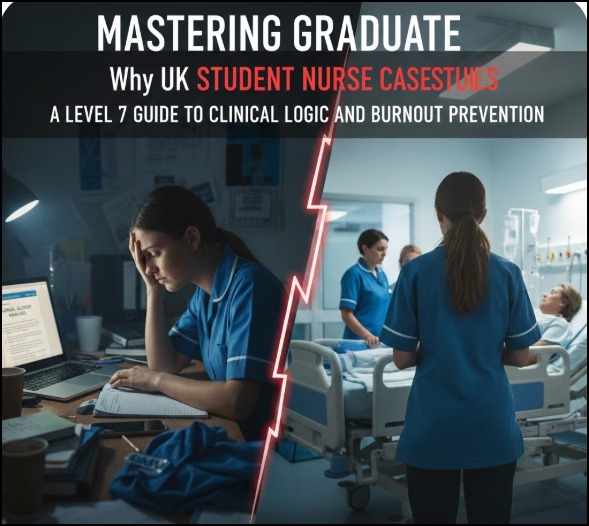
The journey to becoming a registered nurse in the United Kingdom is often described as a “baptism of fire.” For graduate students balancing the rigorous demands of a Level 7 Master’s programme with 12-hour shifts in NHS trusts, the pressure is more than academic—it is systemic. While the public often focuses on the physical exhaustion of the ward, a quieter crisis is brewing in the library: the overwhelming weight of clinical case studies.
As we move into 2026, the question is no longer whether student burnout exists, but whether the current academic structure is sustainable. Why is it that some of the most capable clinical students—those who excel in patient care and emergency response—find themselves at a breaking point when faced with a 4,000-word case study? To answer this, we must look at the “hidden gap” between the ward and the word.
The Anatomy of a Nursing Case Study: More Than Just Paperwork
A nursing case study at the graduate level is not a standard essay. It is a high-stakes demonstration of clinical reasoning, patient safety awareness, and theoretical application. In the UK, these assignments must align with the NMC (Nursing and Midwifery Council) Standards of Proficiency. For a Level 7 student, this requires a level of “Critical Synthesis” that goes far beyond the descriptive writing of undergraduate years.
Key Requirements for Level 7 Success:
- Synthesising Complex Data: You are not just listing symptoms; you are merging patient observations (Subjective and Objective data) with pharmacological knowledge and pathophysiology.
- Applying Reflective Models: Frameworks like Gibbs (1988) or Driscoll (2007) are mandatory. However, at the Master’s level, you must use them to challenge your own practice, not just describe it.
- Navigating Ethics and Law: You must justify clinical decisions using the “Duty of Care,” the Mental Capacity Act 2005, and the principles of the Four Pillars of Nursing.
Why the Case Study is a “Red Flag” for Burnout
Burnout among UK nursing students has reached critical levels. Recent 2025/26 data suggest that nearly 70% of students experience emotional exhaustion before their final placement. The case study often becomes the “tipping point” for several reasons:
1. The “Theory-Practice Gap”
Students are often taught “textbook nursing” in lecture halls—idealized scenarios where every resource is available. They then step onto a busy NHS ward where staffing is short and time is a luxury. When it comes time to write the case study, bridging this gap is intellectually taxing. Students struggle to justify why a specific intervention was missed on a busy ward while maintaining the academic standard that it should have been performed according to NICE guidelines.
2. Cognitive Overload and Shift Work
The UK nursing curriculum requires 2,300 hours of clinical placement. Asking a student to engage in “critical analysis” after a week of night shifts is a recipe for cognitive overload. The brain, exhausted by the “fight or flight” environment of an Emergency Department or an ICU, often lacks the executive function required for the precision of academic writing and Harvard (UK) referencing.
3. The Perfectionism Trap
Nursing attracts high-achievers who are used to being “the reliable one.” However, the fear of making a mistake—either on the ward or in a paper—leads to “analysis paralysis.” Many students spend more time worrying about the structure of their paper than the actual clinical content, leading to sleep deprivation and a decline in mental health.
Technical Spotlight: Mastering the Reflective Element
The “Reflective Cycle” is the most common area where UK students lose marks. To achieve a Distinction at Level 7, the reflection must be critical, not descriptive.
Level 7 Reflective Matrix
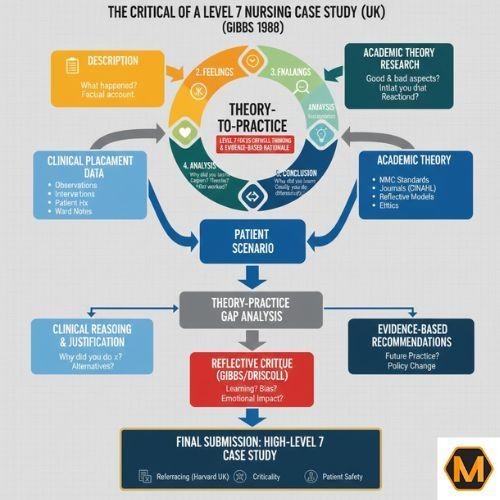
To help you structure your next assignment, use the following framework to ensure you are hitting the “Critical” markers:
| Stage of Gibbs | Common Mistake (2:2 Level) | First-Class / Distinction Approach (Level 7) |
| Description | Spending 50% of the word count on “what happened.” | Keeping it to 10-15%. Focus only on the trigger for the reflection. |
| Evaluation | Saying “I felt bad because the patient was upset.” | Evaluating the effectiveness of the intervention based on patient outcomes. |
| Analysis | Stating “The ward was busy, so I forgot the check.” | Linking the incident to Human Factors and Systems Thinking in healthcare. |
| Conclusion | Saying “I will remember next time.” | Critically questioning the evidence base for current practice. |
| Action Plan | “I will read more about this topic.” | Identifying specific NICE pathways or CPD (Continuing Professional Development) targets. |
Solving the Problem: A Roadmap for the Next Generation
If burnout is not to be “inevitable,” we need to provide students with more than just “resilience training.” We need practical, academic solutions.
1. The Power of “Gold Standard” Examples
One of the most effective ways to reduce anxiety is to see a visual roadmap. Many university guidelines are abstract. By reviewing a high-quality nursing case study writing example, students can see how to transition from “Subjective Data” to “Evidence-Based Intervention.” This allows the student to focus on their unique patient story rather than getting lost in the technicalities of Level 7 formatting.
2. Acknowledging Professional Support
There is an outdated stigma that seeking help is a sign of academic weakness. In reality, modern nursing is about resource management. Just as a nurse would refer a patient to a tissue viability specialist, a student nurse should feel empowered to seek specialist academic support.
Accessing targeted nursing assignment help is often a vital safety net for those at the brink of burnout. Whether it is ensuring the clinical justifications align with the latest SRA and NICE guidelines or refining the “Critical Analysis” sections, professional support allows students to maintain their mental wellbeing while meeting the rigorous demands of the degree.
The Ethics of Support: Mentorship vs. Misconduct
A common “red flag” for students is the fear that seeking help is “cheating.” In the UK, there is a clear distinction:
- Academic Support: Seeking guidance on structure, critical tone, referencing, and the application of evidence-based practice. This is effectively academic mentorship.
- Academic Misconduct: Falsifying patient data, plagiarism, or misrepresenting clinical facts.
In a landscape where the nursing shortage is critical, we cannot afford to lose empathetic students because they couldn’t navigate a complex bibliography while working 40 hours a week for free.
Conclusion: Moving Beyond the “Survival” Mindset
Burnout should not be a rite of passage for UK nurses. If you are a graduate student nurse, remember that your health is as important as your patient’s. If you are struggling with a complex case study:
- Stop and Reflect: Are you stuck on nursing care, or the academic delivery?
- Use Your Resources: Don’t reinvent the wheel. Use high-quality examples to understand the “language” of Level 7 writing.
- Prioritise Executive Function: A 2-hour writing session after a good night’s sleep is more productive than an 8-hour session while exhausted.
The UK healthcare system needs you—but it needs you at your best, not your most broken.
Verified UK Nursing Resources & Data Citations
- Nursing and Midwifery Council (NMC): The Code and Standards of Proficiency for Registered Nurses.
- Royal College of Nursing (RCN): Reports on Student Nurse Burnout and Placement Support (2025).
- NICE Guidelines: The National Institute for Health and Care Excellence—the gold standard for evidence-based practice.
- HESA Data: Statistics on Nursing Graduate Outcomes and Academic Retention (2024-2025).
About The Author
Georgia Taylor is a Senior Education Consultant specialising in nursing curricula and postgraduate academic support. With over a decade of experience bridging the gap between clinical placement and theoretical research, she provides strategic guidance to graduate students navigating the rigours of Level 7 studies. Georgia is passionate about reducing student burnout through better access to evidence-based academic resources.